Theo Di Piazza

MSc, PhD Student


👨‍🎓 PhD Student in Deep Learning for Medical Imaging.

🎓 I hold an engineering diploma in Applied Mathematics from INSA Rennes and a Research Master's degree in Mathematics, Vision, and Machine Learning (MVA) from Ecole Normale Superieure Paris-Saclay. Currently, I am a PhD student working with Philips, Hospices Civil de Lyon and INSA Lyon CREATIS from University of Lyon.

📩 Do not hesitate to reach out for possible collaborations or questions regarding my research!

Publications

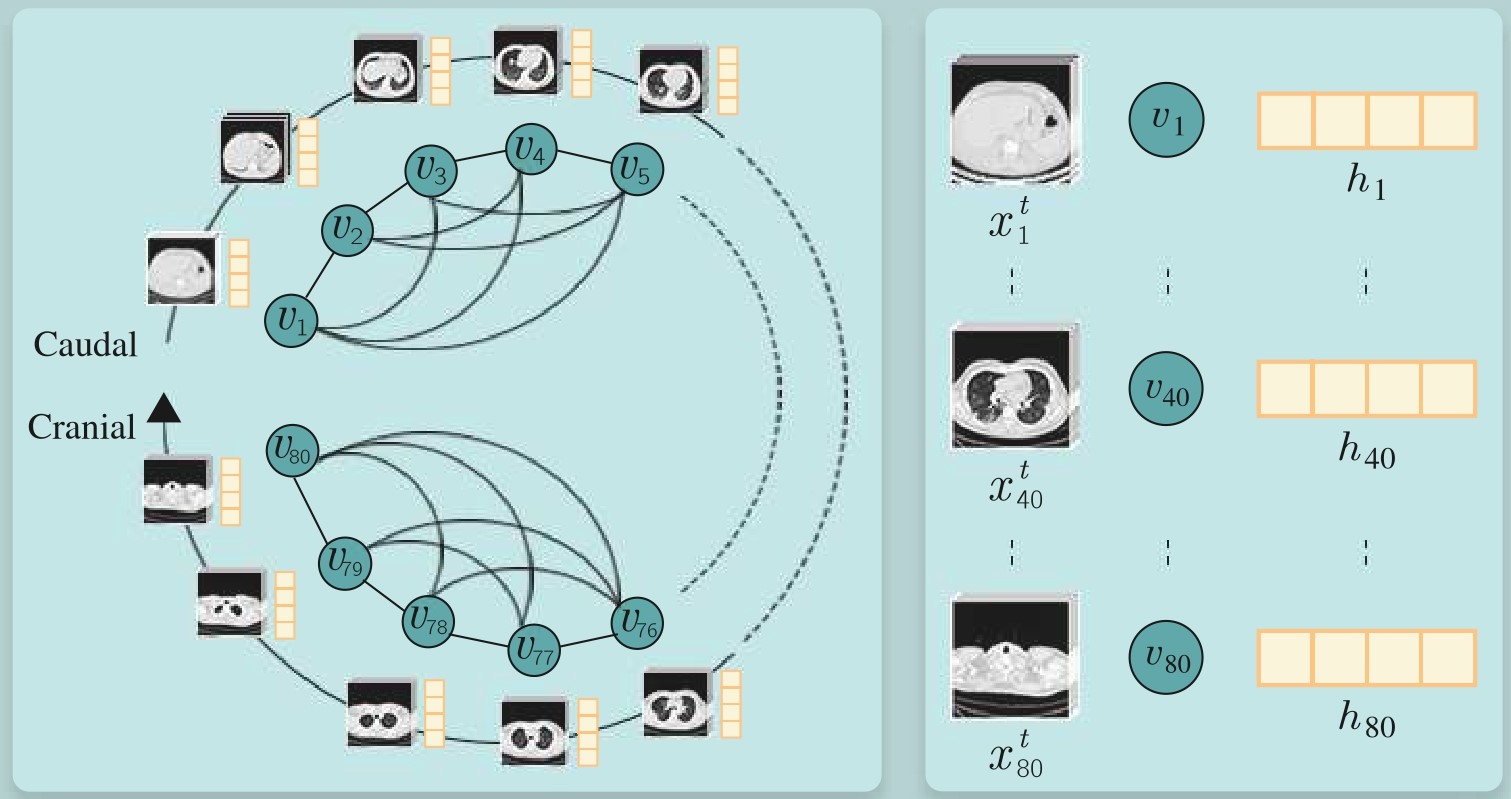
Structured Spectral Graph Representation Learning for Multi-label Abnormality Analysis from 3D CT Scans
Theo Di Piazza, Carole Lazarus, Olivier Nempont and Loic Boussel
MICCAI EMERGE Workshop Oral, 2025
Journal Extension Under Review, 2025

With the increasing number of CT scan examinations, there is a need for automated methods such as organ segmentation, anomaly detection and report generation to assist radiologists in managing their increasing workload. Multi-label classification of 3D CT scans remains a critical yet challenging task due to the complex spatial relationships within volumetric data and the variety of observed anomalies. Existing approaches based on 3D convolutional networks have limited abilities to model long-range dependencies while Vision Transformers suffer from high computational costs and often require extensive pre-training on large-scale datasets from the same domain to achieve competitive performance. In this work, we propose an alternative by introducing a new graph-based approach that models CT scans as structured graphs, leveraging axial slice triplets nodes processed through spectral domain convolution to enhance multi-label anomaly classification performance. Our method exhibits strong cross-dataset generalization, and competitive performance while achieving robustness to z-axis translation. An ablation study evaluates the contribution of each proposed component.

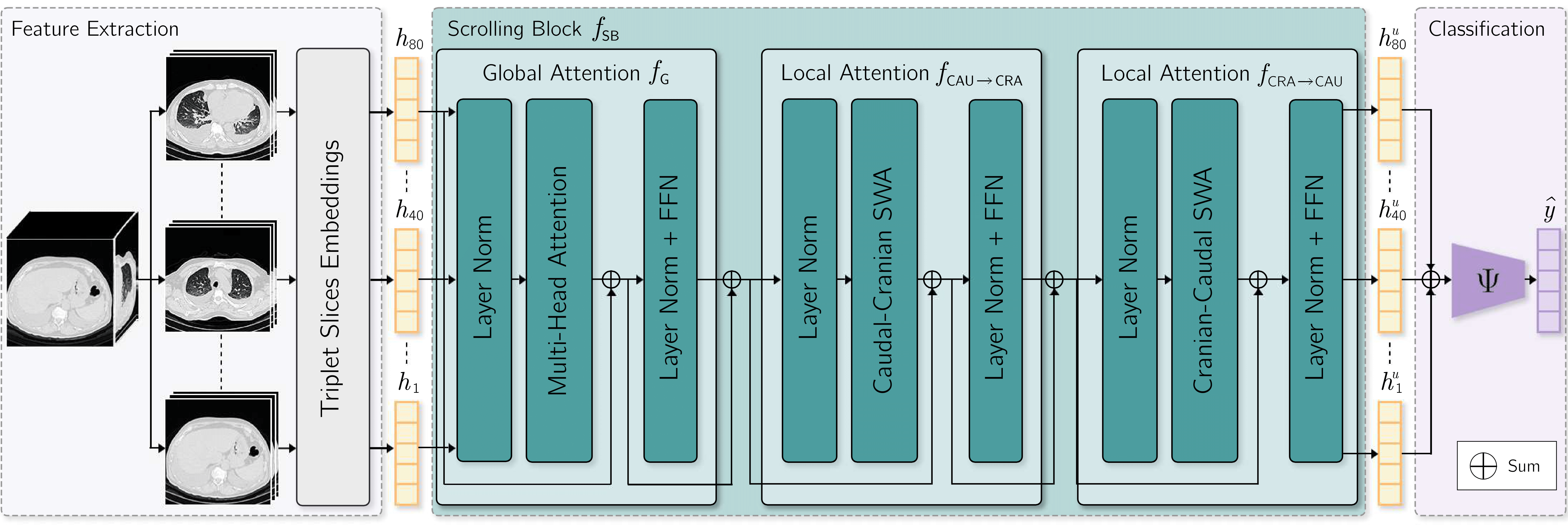
Imitating Radiological Scrolling: A Global-Local Attention Model for 3D Chest CT Volumes Multi-Label Anomaly Classification
Theo Di Piazza, Carole Lazarus, Olivier Nempont and Loic Boussel
MIDL Oral, 2025

The rapid increase in the number of Computed Tomography (CT) scan examinations has created an urgent need for automated tools, such as organ segmentation, anomaly classification, and report generation, to assist radiologists with their growing workload. Multi-label classification of Three-Dimensional (3D) CT scans is a challenging task due to the volumetric nature of the data and the variety of anomalies to be detected. Existing deep learning methods based on Convolutional Neural Networks (CNNs) struggle to capture long-range dependencies effectively, while Vision Transformers require extensive pre-training, posing challenges for practical use. Additionally, these existing methods do not explicitly model the radiologist's navigational behavior while scrolling through CT scan slices, which requires both global context understanding and local detail awareness. In this study, we present CT-Scroll, a novel global-local attention model specifically designed to emulate the scrolling behavior of radiologists during the analysis of 3D CT scans. Our approach is evaluated on two public datasets, demonstrating its efficacy through comprehensive experiments and an ablation study that highlights the contribution of each model component.

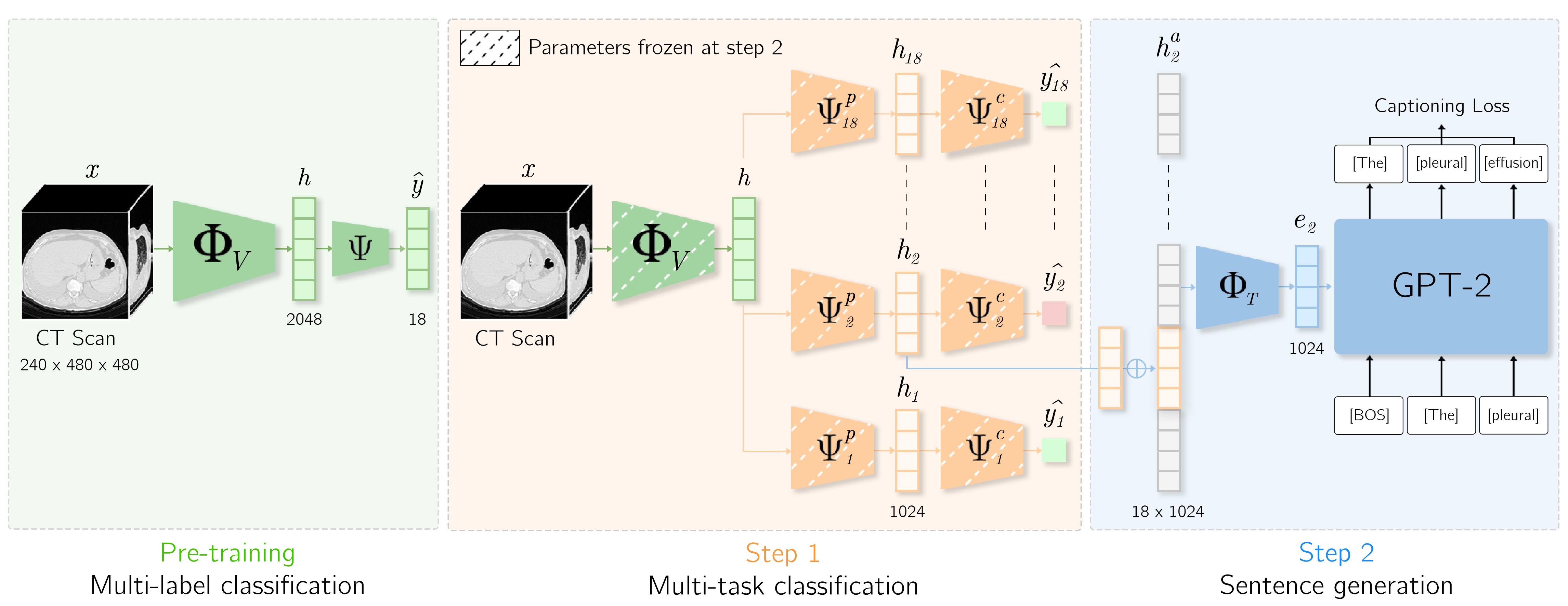
CT-AGRG: Automated Abnormality-Guided Report Generation from 3D Chest CT Volumes
Theo Di Piazza, Carole Lazarus, Olivier Nempont and Loic Boussel
IEEE ISBI Oral, 2025

The rapid increase of Computed Tomography examinations have created a need for robust automated analysis techniques in clinical settings to assist radiologists managing their growing workload. Existing methods generate entire reports directly from 3D CT images, without explicitly focusing on observed abnormalities. This unguided approach can result in repetitive content or incomplete reports. We propose a new anomaly-guided report generation model, which first predicts abnormalities and then generates targeted descriptions for each. Evaluation on a public dataset demonstrates significant improvements in report quality and clinical relevance. We extend our work by conducting an ablation study to demonstrate its effectiveness.

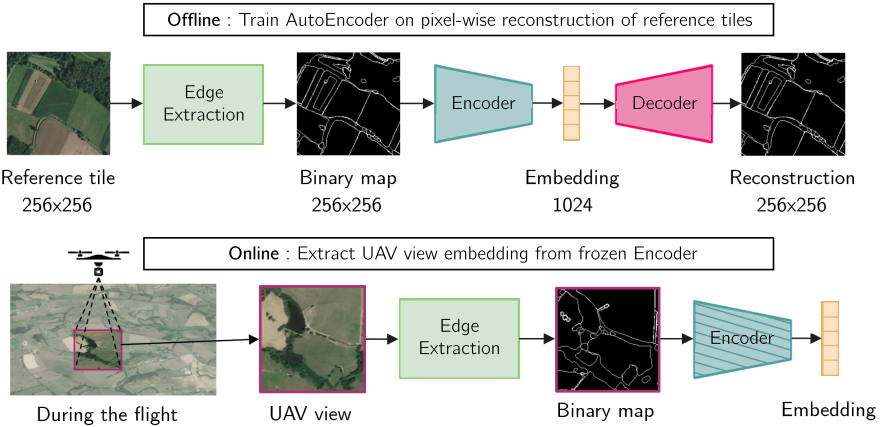
Leveraging Edge Detection and Neural Networks for better UAV localization
Theo Di Piazza, Enric Meinhardt-Llopis, Gabriele Facciolo, Bénédicte Bascle, Corentin Abgrall and Jean-Clément Devaux
IEEE IGARSS Oral, 2024

We propose a new method for the geolocalization of Un-maned Aerial Vehicles (UAV) in environments without Global Navigation Stallite Systems (GNSS). Current state-of-the-art methods use an offline-trained encoder to compute a vector representation (embedding) of the current UAV’s view, and compare it with the pre-computed embeddings of geo-referenced images in order to deduce the UAV’s position. Here, we show that the performance of these methods can be greatly improved by pre-processing the images by extracting their edges, which are robust to seasonal and illumination changes. Moreover, we also show that using edges improves the robustness to orientation and altitude errors. Finally, we present a confidence criterion for localization. Our findings are validated using synthetic experiments.

Community

Reviewer for ISBI (2025), and MIDL (2026).

Copyright © Theo Di Piazza  /  Last update December 2025
Recycled from here